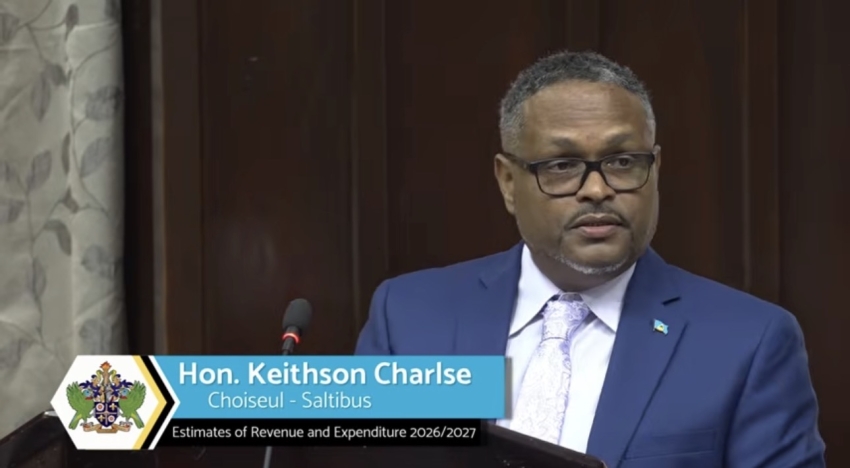
Addressing the House, Charles framed the Budget as more than a fiscal exercise, describing it as a “fiscal covenant” and “the legislative engine that drives our national mandate.” He stated, “I support this bill, Mr Speaker, because it is the legislative engine that drives our national mandate. Discipline in our management, delivery in our infrastructure, dignity for our people.”
He anchored his speech around what he termed the “three Ds” of governance. “Discipline, delivery, dignity. Let us call them the three Ds,” he said, adding that this represents “the true three D vision” guiding the administration.
The minister argued that the Appropriation Bill transforms planning into execution, stating that “if the estimates were technical drawings, then the appropriation bill is the building permit.” He added that it represents “the sovereign authority that transforms plan into practice.”
Charles praised the fiscal direction of the government under Prime Minister Philip J. Pierre, crediting it with stability in a volatile global environment. He pointed to headline fiscal indicators, including a recurrent revenue of $1.75 billion and a current surplus of $243.6 million, describing them as evidence of disciplined management.
“These surpluses are not money held in a vault,” he said. “They are the strategic platform granting us the credibility and capacity for delivery.”
He also announced that government will operationalise a Sovereign Wealth Fund, describing it as “not just a rainy day fund, but a nation-building fund,” with an initial focus on climate adaptation.
Turning to energy, Charles acknowledged public frustration over rising electricity costs. “I hear them. I hear the conversations in the shops in Choiseul and Saltibus,” he said, referencing public reaction to recent electricity bills.
He attributed rising costs to global oil markets, stating, “As long as we remain shackled to imported fossil fuels, our people’s pockets are at the mercy of geopolitical winds in the Middle East.” He added that renewable energy expansion is therefore “not merely environmental policy. It is an independence policy.”
Charles emphasised investments in geothermal energy, noting a $7.85 million allocation under the Renewable Energy Sector Development Project. He said this forms part of a broader strategy to achieve “national energy independence” through solar, wind and geothermal sources.
On water infrastructure, the minister described longstanding inefficiencies in the system, stating that “nearly half of all water produced was lost before reaching a single home.” He said government is now undertaking “a data-driven transformation,” including rehabilitation of pipelines and upgrades to treatment facilities.
He further promoted rainwater harvesting as a key resilience strategy, stating, “Every gallon harvested for non-potable use relieves pressure on WASCO.” He added that such measures are aligned with international models of decentralised water management.
In the area of land reform, Charles highlighted the Crown lands regularisation programme, describing it as “a moral imperative.” He said the initiative will convert informal occupation into legal ownership for qualifying residents, arguing that it will “unleash economic potential” and correct “a decades-old wound.”
He also announced the development of a digital land registry valued at $1.6 million, which he described as “not an IT upgrade. It is the democratisation of land administration.” The system, he said, will reduce transaction times and improve access to property services.
“By modernising the registry, we unlock dead capital,” he stated, adding that land ownership is “the collateral to start a business, fund a child’s education, or secure a mortgage.”
Charles also addressed broader governance themes, stating that the government is shifting from “reactive patching to proactive visionary stewardship.” He argued that infrastructure development must be rooted in planning, stating, “You cannot build a roof before you lay the foundation.”
In concluding his contribution, the minister urged colleagues to support the Bill, framing it as essential to national progress.